|
|
|
 |
|
|
| |
E-mail: tom@stroutfitters.com |
Toll Free: 877.246.4896 |


Striking a hit with stripers
Posted on Thursday, January 3, 2008
|
MOUNTAIN HOME — There is far more activity below the
surface than above on a typical winter day at Norfork Lake. The depths are teeming with schools of hefty stripers that
are neither difficult to find nor catch. Year-round guide Tom Reynolds believes
many anglers hibernate because they simply aren’t aware of the potential of
cold-weather fishing. “You don’t have to get out early or stay late,” he said.
Interested persons can contact Tom Reynolds at (870 ) 491-5582 or (877 ) 246-4896 or the Highway 101 Bait Shop at (870 ) 467-5223. Copyright © 2001-2008 Arkansas Democrat-Gazette, Inc. All rights reserved. Contact: webmaster@nwanews.com |
 “Fish any time of the day in the winter and you’ll likely find some stripers
that are feeding.” In fact, Reynolds says, novice anglers willing to brave the
elements and mimic his simplistic approach are more likely to succeed December
through February than any other time of year. The first step is to go to the
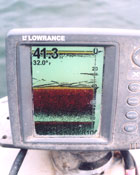
mouth of a good-size tributary creek. The second is to search water 50-80 feet
deep for schools of shad, using a sonar unit. Typically, the shad will be 36-44
feet deep and the stripers will be nearby. Reynolds proved his prowess on a
mid-December day when temperatures never broke out of the 30 s. The outing began
at 9 a. m. and by noon we had landed a half-dozen stripers. It took the veteran
guide about 30 minutes to find the shad and accompanying stripers. They were in
40-45 feet of water, close to the bottom and along a ledge that dropped to 52
feet. We caught fish for several hours in that one spot, in part because it was
too doggone cold to go elsewhere.
“Fish any time of the day in the winter and you’ll likely find some stripers
that are feeding.” In fact, Reynolds says, novice anglers willing to brave the
elements and mimic his simplistic approach are more likely to succeed December
through February than any other time of year. The first step is to go to the
mouth of a good-size tributary creek. The second is to search water 50-80 feet
deep for schools of shad, using a sonar unit. Typically, the shad will be 36-44
feet deep and the stripers will be nearby. Reynolds proved his prowess on a
mid-December day when temperatures never broke out of the 30 s. The outing began
at 9 a. m. and by noon we had landed a half-dozen stripers. It took the veteran
guide about 30 minutes to find the shad and accompanying stripers. They were in
40-45 feet of water, close to the bottom and along a ledge that dropped to 52
feet. We caught fish for several hours in that one spot, in part because it was
too doggone cold to go elsewhere.  winter, they are just as good as shad — better actually, because you may catch
two or three fish before the shiner is killed. I can get shad in the winter by coming down to one of these
boat docks and dropping a net down into deep water around a light. But why do
that when [stripers ] like the shiners just as well and they are so hardy ?” In
spring, summer and fall, shiners will not catch stripers as well as live shad,
the veteran guide said. Reynolds also suggests that those visiting Highway 101
Bait Shop check with owner Tim Parkin for the latest reports on striper action.
winter, they are just as good as shad — better actually, because you may catch
two or three fish before the shiner is killed. I can get shad in the winter by coming down to one of these
boat docks and dropping a net down into deep water around a light. But why do
that when [stripers ] like the shiners just as well and they are so hardy ?” In
spring, summer and fall, shiners will not catch stripers as well as live shad,
the veteran guide said. Reynolds also suggests that those visiting Highway 101
Bait Shop check with owner Tim Parkin for the latest reports on striper action.
 monofilament line in strengths of 8-10
pounds. Below a swivel, he has 8 feet of clear, 14-pound leader and a 2 / 0
circle hook, which he swears by. When fishing directly below the boat, he puts a
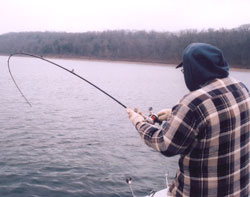
2-ounce sliding sinker above the swivel. Once a shiner is added to the hook, Reynolds sets the rod in a
rod holder and keeps an eye on it. When a striper takes the bait, the tip of the
long, light rod actually dips into the water and all that’s left to do is lift
the rod from the holder and begin the battle. The circle hook has already
penetrated, eliminating the need for a strong hookset. Reynolds said stripers in clear water sometimes are wary of a
boat immediately overhead, in which case he uses small, biodegradable balloons
to take the bait out from the boat. Planer boards, popular in Northern states
among walleye anglers, also will work. With a balloon, Reynolds uses only a half ounce of weight above
his swivel. He counts out 40 feet of line, makes a 12-inch loop in the line,
then inflates the balloon to a size just smaller than a tennis ball and ties the
stem of the balloon around the loop. The balloon doesn’t act as a bobber, but rather suspends the
bait so it can drift 30-40 yards from the boat. When a striper takes the bait, the line is pulled through the
stem of the balloon and the balloon floats free.
monofilament line in strengths of 8-10
pounds. Below a swivel, he has 8 feet of clear, 14-pound leader and a 2 / 0
circle hook, which he swears by. When fishing directly below the boat, he puts a
2-ounce sliding sinker above the swivel. Once a shiner is added to the hook, Reynolds sets the rod in a
rod holder and keeps an eye on it. When a striper takes the bait, the tip of the
long, light rod actually dips into the water and all that’s left to do is lift
the rod from the holder and begin the battle. The circle hook has already
penetrated, eliminating the need for a strong hookset. Reynolds said stripers in clear water sometimes are wary of a
boat immediately overhead, in which case he uses small, biodegradable balloons
to take the bait out from the boat. Planer boards, popular in Northern states
among walleye anglers, also will work. With a balloon, Reynolds uses only a half ounce of weight above
his swivel. He counts out 40 feet of line, makes a 12-inch loop in the line,
then inflates the balloon to a size just smaller than a tennis ball and ties the
stem of the balloon around the loop. The balloon doesn’t act as a bobber, but rather suspends the
bait so it can drift 30-40 yards from the boat. When a striper takes the bait, the line is pulled through the
stem of the balloon and the balloon floats free. 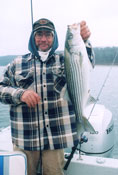 caught. The lake also holds tons of big white bass, and a couple of fellows with
a bucketful of shiners had caught a bunch of them a day or so before my trip
with Reynolds. Most of those exceeded 3 pounds. A personal best from Norfork was
a 14-pound hybrid a couple of years ago caught in February. Hybrids occasionally
mix with the stripers and are prolific fighters. A striped bass is a long way from what old-time Ozark anglers
think of as a fish. They aren’t native, but an ocean species which run up into
freshwater rivers to spawn. When Santee-Cooper Reservoir was created in South Carolina in
1941, the gates were closed on thousands of stripers that were spawning in its
tributaries. Biologists didn’t figure much would come of it, but the stripers
thrived. Anglers started catching a few, and with some natural reproduction,
striper fishing became a Southeastern craze. States to the west began to obtain fingerlings, and the striper
became adapted to Southern and Midwestern reservoirs as the trophy fish everyone
wanted to catch. Occasionally, stripers are able to spawn in those reservoirs,
but to do so they must have many miles of flowing river for the eggs to roll
along. Biologists have said they think successful spawns have occurred in the
North Fork River above Norfork Lake in years when the river flooded just at the
right time in spring. Reynolds said stripers in Norfork are about 20 inches long
by age 2, making the lake’s 20-inch minimum length limit just right. Mature
Norfork stripers are 22-24 inches.
caught. The lake also holds tons of big white bass, and a couple of fellows with
a bucketful of shiners had caught a bunch of them a day or so before my trip
with Reynolds. Most of those exceeded 3 pounds. A personal best from Norfork was
a 14-pound hybrid a couple of years ago caught in February. Hybrids occasionally
mix with the stripers and are prolific fighters. A striped bass is a long way from what old-time Ozark anglers
think of as a fish. They aren’t native, but an ocean species which run up into
freshwater rivers to spawn. When Santee-Cooper Reservoir was created in South Carolina in
1941, the gates were closed on thousands of stripers that were spawning in its
tributaries. Biologists didn’t figure much would come of it, but the stripers
thrived. Anglers started catching a few, and with some natural reproduction,
striper fishing became a Southeastern craze. States to the west began to obtain fingerlings, and the striper
became adapted to Southern and Midwestern reservoirs as the trophy fish everyone
wanted to catch. Occasionally, stripers are able to spawn in those reservoirs,
but to do so they must have many miles of flowing river for the eggs to roll
along. Biologists have said they think successful spawns have occurred in the
North Fork River above Norfork Lake in years when the river flooded just at the
right time in spring. Reynolds said stripers in Norfork are about 20 inches long
by age 2, making the lake’s 20-inch minimum length limit just right. Mature
Norfork stripers are 22-24 inches. 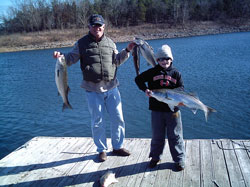 stripers in winter on
Norfork Lake are from Bidwell Point to Bennett’s Bayou, Panther Bay, Float
Creek, Cranfield Bay, Big Creek and Brushy Creek. In winter, the fish are more consistent in their behavior than
any other season. There are usually mild days in a north Arkansas winter, and
the fishermen are sure to react by heading to the lake. But the stripers won’t
notice 40 feet below the surface, where the water temperature is about 52
degrees all winter long. They’ll just keep eating, fishermen or not.
stripers in winter on
Norfork Lake are from Bidwell Point to Bennett’s Bayou, Panther Bay, Float
Creek, Cranfield Bay, Big Creek and Brushy Creek. In winter, the fish are more consistent in their behavior than
any other season. There are usually mild days in a north Arkansas winter, and
the fishermen are sure to react by heading to the lake. But the stripers won’t
notice 40 feet below the surface, where the water temperature is about 52
degrees all winter long. They’ll just keep eating, fishermen or not.
|
STR OUTFITTERS
|
Last Updated:
04/17/2017
Copyrighted All Rights Reserved